Bakersfield behavioral health: how to choose care

Choose behavioral health care in Bakersfield by confirming the exact organization and clinician, whether care can be provided where you will attend sessions, and whether the service addresses your needs. Then verify ongoing appointment availability and payment arrangements. A California online-care description does not, by itself, establish current Bakersfield access or suitability for your situation.
Expand key insights ▾
- A broad search can mix organizations with different roles.
- Online care still requires confirmation of your physical session location.
- Match the service to your need, not the provider's headline.
- An assessment opening does not establish ongoing appointment availability.
- Resolve clinical fit and practical access before committing.
Table of Contents
- Which organization are you trying to reach?
- What service would address the need you have?
- Does the provider's location match where you can receive care?
- Is an available appointment the start of usable ongoing care?
- How would these choices work in a real-life situation?
- When does a specialist handoff change the decision?
- Make a focused inquiry with our practice
- Frequently Asked Questions
A search for Bakersfield behavioral health can bring together a named hospital, county services, substance use programs, and individual therapy options. Those are different starting points, even when their descriptions use similar language. A convenient appointment is useful only if it connects you to the care you need.
Start with a short description of the problem and any fixed access constraint, such as needing in-person care or medication-related help. Then separate what an organization does from what a particular clinician can currently provide. This approach helps you compare local and online options without assuming that either is automatically the better choice.
Which organization are you trying to reach?
If you mean Bakersfield Behavioral Healthcare Hospital, use that full name rather than the broader phrase "behavioral health." Kern Behavioral Health & Recovery Services is a different organization, not another name for the hospital. The Community Service Organization Behavioral Health Program/Brotherhood Center is another distinct name you may encounter.
This distinction changes the first step: a hospital inquiry, a county-service inquiry, and an inquiry about an individual clinician should not be treated as interchangeable. Establish the organization before relying on any address, intake instructions, or payment information.
When you reach a contact page or telephone number, check whose office will receive the inquiry. A referral service may help you search, but that is different from speaking with the provider responsible for appointments. Ask whether you are contacting the organization directly and which program the person answering represents.
Also distinguish the organization from the treating clinician. A practice or facility name may cover several services, while the professional assigned to you may have a narrower role. You need the identity of the service you would actually enter, not simply a recognizable name.
What service would address the need you have?
Describe what you need help with before choosing a treatment label. "I want regular conversations about anxiety" is a different request from "I need someone to review my medication" or "I need help deciding whether outpatient care is enough." You do not need to diagnose yourself to explain those differences.
Behavioral health is a broad category. Do not infer medication services from a counseling description, or substance use treatment from a general mental health specialty list. Ask what the proposed service involves and who provides each part.
The comparison below explains different care functions. It does not establish which Bakersfield organization currently provides them or which level of care is appropriate for you.
| Care function | What you are trying to establish | Decision-changing question |
|---|---|---|
| Ongoing outpatient counseling | A setting for recurring work on your concerns | Does the clinician work with my concern and offer a schedule I can sustain? |
| Medication-related care | Access to a professional responsible for medication evaluation or management | Who would address medication questions, and is that part of this service? |
| Substance use care | Support that addresses substance use alongside relevant mental health needs | Can this program address both needs, or would another service be involved? |
| Higher-intensity assessment or treatment | Whether additional structure or monitoring is needed | Who can assess the appropriate level of care and arrange the next step? |
Separate a specialty from a service
A clinician may work with people who experience depression without providing every type of depression-related care. Likewise, discussing substance use in therapy does not establish access to withdrawal management or a structured recovery program. Ask for an explanation of the actual work, not a longer list of conditions.
For recurring therapy, the proposed process should connect to your goal. For assessment, medication, or program-based care, establish the responsible professional and the pathway into that service. Our guide to choosing a therapist can help with the working relationship after you have narrowed the correct care function.
Does the provider's location match where you can receive care?
Separate the office address, the area a practice serves, and your physical location during appointments. These details answer different questions. A Bakersfield address does not establish that a particular program is accepting you, and a California online-care description does not establish a current appointment option for you in Bakersfield.
For in-person care, obtain the address of the actual appointment site. Ask whether the assessment and follow-up visits happen at the same location. Use that confirmed destination to assess your own transportation and scheduling needs rather than relying on a general city label.
For online care, tell the practice where you will physically attend sessions. Ask whether the proposed clinician can provide that service from your stated location, and whether any travel or move would affect the arrangement. Do not treat a video appointment as permission to receive care from any location.
Compare the appointment setting, not just convenience
Online care may remove a transportation barrier while introducing a privacy problem. In-person care may give you a separate space to talk but require time away from work or other responsibilities. Neither advantage settles the clinical question of whether the service meets your needs.
Before relying on online appointments, consider whether you can speak freely, protect the time from interruptions, and use a dependable device and connection. Ask the provider about connection failures and urgent concerns during a session. Our telehealth therapy guide provides related questions about the appointment format.
If your location will change, raise that before starting. The useful answer is a clear explanation of what can continue and what would require a different arrangement, not a general reassurance that online care is flexible.

Illustration contrasting a route to an office doorway with laptop use in a private room. Location pins mark both settings, and a question mark separates the scenes.
Is an available appointment the start of usable ongoing care?
An opening for a consultation or assessment is not the same as an opening for recurring treatment. Establish what the first appointment is for, whether it leads to a treatment decision, and how subsequent appointments are scheduled. Otherwise, you may compare an assessment slot with another provider's actual treatment opening.
Ask about the appointment pattern you could maintain. If you need a consistent time, distinguish a recurring slot from occasional cancellations. If a program requires attendance that conflicts with your responsibilities, discuss that conflict before treating the program as accessible.
Cost also belongs in this decision. Request the current charge for the proposed service and any separate assessment or program charges. If you plan to use insurance, check the arrangement with both the provider and your plan rather than treating "insurance accepted" as a complete answer about your costs.
For a waitlist, clarify what happens while you wait and whether any interim service is actually available. A waitlist can be reasonable for a nonurgent need, but it should not be mistaken for active treatment. Avoid canceling existing support solely because another provider has accepted an inquiry.
Record the outcome in plain language: "ongoing time confirmed," "assessment only," or "waiting for a treatment opening." Those distinctions make your shortlist more useful than ranking providers by how quickly they respond.
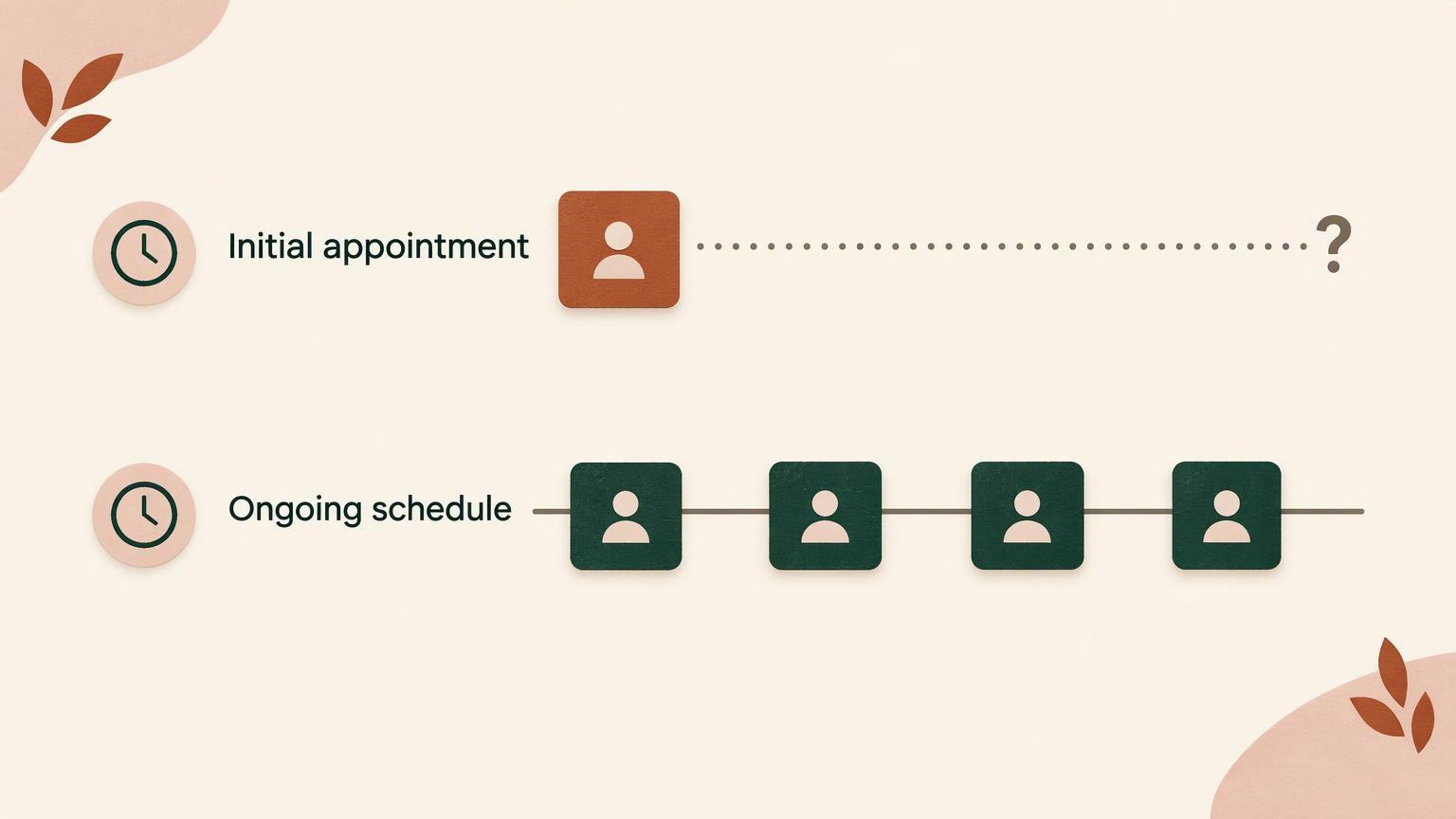
Illustration contrasting “Initial appointment,” with one tile and a dotted path to a question mark, with “Ongoing schedule,” shown as four evenly spaced green tiles on a continuous line.
How would these choices work in a real-life situation?
Consider an explicitly hypothetical Bakersfield reader who wants recurring counseling and also has an unresolved medication question. Their fixed constraint is that appointments must fit around work. They have a private setting for video sessions, but they do not yet know whether the proposed online clinician can serve their location.
The options below are invented decision examples, not descriptions of actual providers, openings, or program capabilities.
If counseling is appropriate and the local recurring appointment fits, that option may be practical even though medication care must be arranged separately. The online option becomes comparable only after location eligibility and a usable schedule are established. A preferred approach cannot compensate for an appointment that cannot actually take place.
If the uncertainty concerns the appropriate level or type of care, an assessment may be the better first step. The deciding factor is the unresolved clinical question, not whether one organization can bundle every service. Separate services can work when responsibilities are clear; a single organization can still leave a gap if the needed service is unavailable.
| Option | Potential fit | Unresolved dependency | Choice that follows |
|---|---|---|---|
| Local counseling option with a workable recurring time | Could address the counseling goal | Medication-related care is separate | Pursue counseling if appropriate while arranging the medication question with the relevant professional |
| Online counseling option with a preferred approach | Could fit the reader's privacy and schedule | Location eligibility and recurring availability remain unknown | Keep it under consideration, but do not treat access as established |
| Program offering an initial assessment | Could help clarify the required service | Assessment does not establish suitable ongoing treatment | Use the assessment pathway if clarification is needed, then evaluate the resulting plan |
| Option | Potential fit | Still unresolved | Next step |
|---|---|---|---|
| Local counseling | Workable recurring time | Medication care is separate | Arrange medication care separately |
| Online counseling | Preferred approach; private video space | Location eligibility and recurring time | Confirm access before choosing |
| Initial assessment | Clarifies the required service | Suitable ongoing treatment | Assess, then evaluate the resulting plan |
When does a specialist handoff change the decision?
A provider who identifies a need outside their role may be helping you reach more appropriate care. The question is whether the handoff gives you a usable next step. Distinguish a suggestion to search elsewhere from an arranged referral, and do not assume either guarantees acceptance by another service.
If counseling and another service will run alongside each other, establish who is responsible for each part. Ask how coordination would work, what information might be shared with your permission, and whom you should contact about questions that cross between services.
For a transition from a program to ongoing appointments, clarify whether follow-up care is arranged or still needs to be found. Ask who handles questions during the transition and whether you need to complete another assessment. The relevant issue is continuity, not simply receiving a referral name.
If there is immediate danger or you cannot stay safe, seek emergency assistance rather than waiting for a routine consultation or an unanswered online inquiry. If urgency is uncertain, describe it plainly to a qualified health professional and request guidance about the appropriate next step. This comparison cannot determine a safe level of care for you.
Make a focused inquiry with our practice
If you are considering our practice, contact us with your location and the kind of help you are seeking. Ask whether we currently serve your location and whether an appropriate option is available. This inquiry is a way to establish access, not confirmation of Bakersfield coverage.
A useful message could be: "I will attend appointments from Bakersfield. I am looking for recurring counseling about [your concern], and I need [your appointment constraint]. Can you let me know whether there is an appropriate current option and what the next step would involve?"
You can keep the initial description brief. If you also need medication-related care, substance use treatment, or an assessment, name that separately so the question concerns the actual service you need. You do not have to provide a detailed personal history to explain the purpose of your inquiry.
Find out whether there is an appropriate current option.
Explore more from Salonia Singh Therapy — Premium Preview
Do I need a diagnosis before contacting a provider?
How much should I expect to pay?
Can I contact a practice on behalf of an adult family member?
What should I do if nobody responds to my inquiry?
What information should I prepare for an initial assessment?
Can I change providers after care begins?
Choose based on resolved questions
Ready to talk?
Request a free consultation, call 818-570-2527 or email therapycontact@saloniasinghtherapy.com.