Couples therapy vs marriage counseling: what's actually different?
Couples therapy and marriage counseling often refer to the same relationship-focused work. The wording alone does not reliably distinguish depth, duration, methods, or provider qualifications. A provider may use the terms differently, so ask what each means in their practice, what sessions would involve, and how their approach connects to your concerns and goals.
Table of Contents
- Do the labels describe different services?
- What focus fits the concern you want help with?
- How should you compare a marriage counselor and a couples therapist?
- What would sessions involve, and how would privacy work?
- How do you choose when your priorities differ?
- When should safety change the starting point?
- Exploring fit with this practice
- Frequently Asked Questions
Comparing couples therapy vs marriage counseling is useful if it helps you understand the care you are considering. It becomes less useful if you assume that counseling means quick advice while therapy means deeper work, or that being married determines which service fits.
You may want help with a repeated argument, a loss of trust, or a decision about your future together. Those concerns deserve more than a label. The practical comparison is between providers' explanations of what they would work on, how they would work with both of you, and what arrangements you would be agreeing to.
Do the labels describe different services?
Often, they do not. Couples therapy is also known as couples counseling, marriage counseling, or marriage therapy. These names can describe work focused on the relationship rather than treatment directed solely at an individual partner.
Marriage counseling names marriage explicitly; couples therapy uses broader relationship language. That difference in wording does not establish whom a particular provider accepts, whether they work with separated partners, or what goals they support.
Likewise, do not assume marriage counseling avoids emotional history or that couples therapy cannot address an immediate disagreement. A provider might distinguish the terms by focus, but that is something to clarify with that provider rather than a dependable rule across practices.
A useful opening question is: "Do you use couples therapy and marriage counseling interchangeably, or do they describe different services here?" If the answer is that they are different, ask for the practical difference: who attends, what the work addresses, and how the plan is chosen.
| Service label | Usual focus | What to clarify |
|---|---|---|
| Couples therapy | The partners' relationship and interactions | Eligibility, approach, goals, and meeting structure |
| Marriage counseling | Relationship work described in the context of marriage | Whether this differs from couples therapy in that practice |
| Individual therapy | One person's concerns and well-being | How relationship concerns would be addressed without joint sessions |
| Service label | Focus | Ask about |
|---|---|---|
| Couples therapy | Partners' relationship and interactions | Eligibility, approach, goals, structure |
| Marriage counseling | Relationship work in marriage | Whether labels differ in this practice |
| Individual therapy | One person's concerns and well-being | Relationship concerns without joint work |
What focus fits the concern you want help with?
Start with an interaction you want to understand or change. "We argue about spending" gives a provider a subject; "A spending question turns into accusations, and then we avoid talking about money" gives them a pattern to explore.
Relationship-focused work can address communication, trust, conflict, and the effects of major life changes. The selection question is where you want the work to begin, not whether your concern sounds serious enough for the word therapy.
Immediate problems and recurring patterns can belong in the same plan
You might need an immediate way to discuss household responsibilities while also wanting to understand why those conversations repeatedly leave someone feeling dismissed. Those are related goals, not proof that you need separate services called counseling and therapy.
Ask how a provider would balance the current disagreement with the pattern around it. A focus on a practical agreement may suit an urgent decision but leave broader questions untouched; starting with emotional history may feel too distant from the conversation you need to have this week.
A useful explanation connects both parts without promising to solve everything at once. Listen for how the provider would choose a starting point with you and reconsider it if your needs change.
Keep individual needs visible without making one partner the whole problem
If you want private support with your own distress, reactions, or decisions, individual therapy is a different option to discuss. Relationship concerns can be part of individual work, but that arrangement does not provide the same opportunity to observe and discuss both partners' interactions together.
Some people pursue individual and joint work alongside each other. Before choosing that arrangement, discuss the purpose of each and how privacy and coordination would work; do not assume the same provider can or should fill both roles.
How should you compare a marriage counselor and a couples therapist?
Compare their relevant qualifications and how they explain their work, rather than treating either service label as a credential. Ask about professional licensure, training in relationship-focused work, and experience with the concern you described.
Then ask the provider to connect that background to your needs. Experience with couples is a useful starting point, but you still need to understand how they would approach a disagreement about parenting, damaged trust, or uncertainty about staying together.
For example: "When we disagree, one of us pushes for an answer and the other stops talking. How would you begin working with that?" You are asking for a plain-language explanation, not a diagnosis during an introductory conversation.
A method name needs an explanation
An approach such as Emotionally Focused Therapy may draw attention to emotional connection and the interaction cycle around conflict. A list of methods, however, does not tell you what the provider would ask you to do or how they would choose a focus.
Ask whether sessions would include guided conversations, reflection on recurring interactions, practical exercises, or other work, and why. If a provider names several approaches, ask how they decide which elements to use rather than assuming more names mean a better fit.
Your relationship context belongs in the comparison
Describe any family expectations, cultural commitments, or differences in values that affect the concern. Wanting more independence while preserving family connection is different from wanting distance from relatives; a provider should not have to guess your goal.
Also distinguish a preference from a requirement. You might prefer a provider who shares an aspect of your identity while requiring someone who can discuss a particular family conflict without assuming that either partner represents an entire community.

Illustration of a research desk with three sheets of conversation shapes and process diagrams, a magnifying glass, and an open notebook marked with question marks.
What would sessions involve, and how would privacy work?
Relationship-focused sessions commonly include both partners and discussion of what has been happening, how each person understands it, and what each hopes will change. The exact sequence and meeting arrangements depend on the provider.
Ask how the opening appointments are organized and what happens when you have different accounts of the same event. You do not need to agree on a single explanation before asking for help, but you should understand how the provider would make room for both perspectives.
If you expect direct advice and your partner expects open-ended discussion, name that difference early. Otherwise, an arrangement that seemed clear during booking may feel quite different once the work begins.
Clarify separate conversations before using them
Ask whether the provider meets partners separately, what those meetings are for, and how information shared there is handled. Also ask what happens to information sent by email or messages outside a joint appointment.
Do not assume a private conversation with the couples provider follows the same arrangement as your own individual therapy. Request a clear explanation of confidentiality, its limits, access to records, and any policy about information kept from the other partner before sharing sensitive details.
Define the working role
If you want the therapist to determine who is right, say so and ask how they understand their role. Relationship-focused work is generally concerned with understanding interactions and helping partners address them, rather than issuing a verdict on every disagreement.
That does not mean every action carries equal responsibility. Ask how the provider addresses harmful behavior and accountability while hearing both partners, especially if you worry that your concerns will be reduced to a shared communication problem.
How do you choose when your priorities differ?
Choose based on whether the proposed work makes room for both priorities, not whether both of you favor the same label. Write down what each person wants to change and where those goals overlap.
Say you keep arguing about visits with relatives. You want a workable agreement before the next visit; your partner wants to understand why every request feels like choosing between family and the relationship.
A provider called a marriage counselor might address both the agreement and its emotional meaning. A provider called a couples therapist might do the same. Choosing solely by the title would not tell you which one can explain a starting plan that makes sense to both of you.
Compare their actual responses. A plan centered only on scheduling may leave your partner's concern unaddressed; a plan centered only on exploring family history may not help you approach the upcoming visit. The better fit is the provider who can explain how those needs would be balanced, while being honest about what cannot be settled immediately.
Use goals you can revisit
"We want a better relationship" is a reasonable wish, but it leaves progress hard to discuss. A more specific goal might be to talk about family visits without accusations and reach decisions both people can explain.
Ask how goals are reviewed and what happens if the work does not seem connected to them. Possible signs of change include staying engaged during a difficult conversation or returning to it after a pause; these are goals to discuss, not promised results.
If one partner wants reconciliation and the other is uncertain, disclose that difference. Ask whether the provider works with differing relationship goals and what kind of starting conversation they recommend.
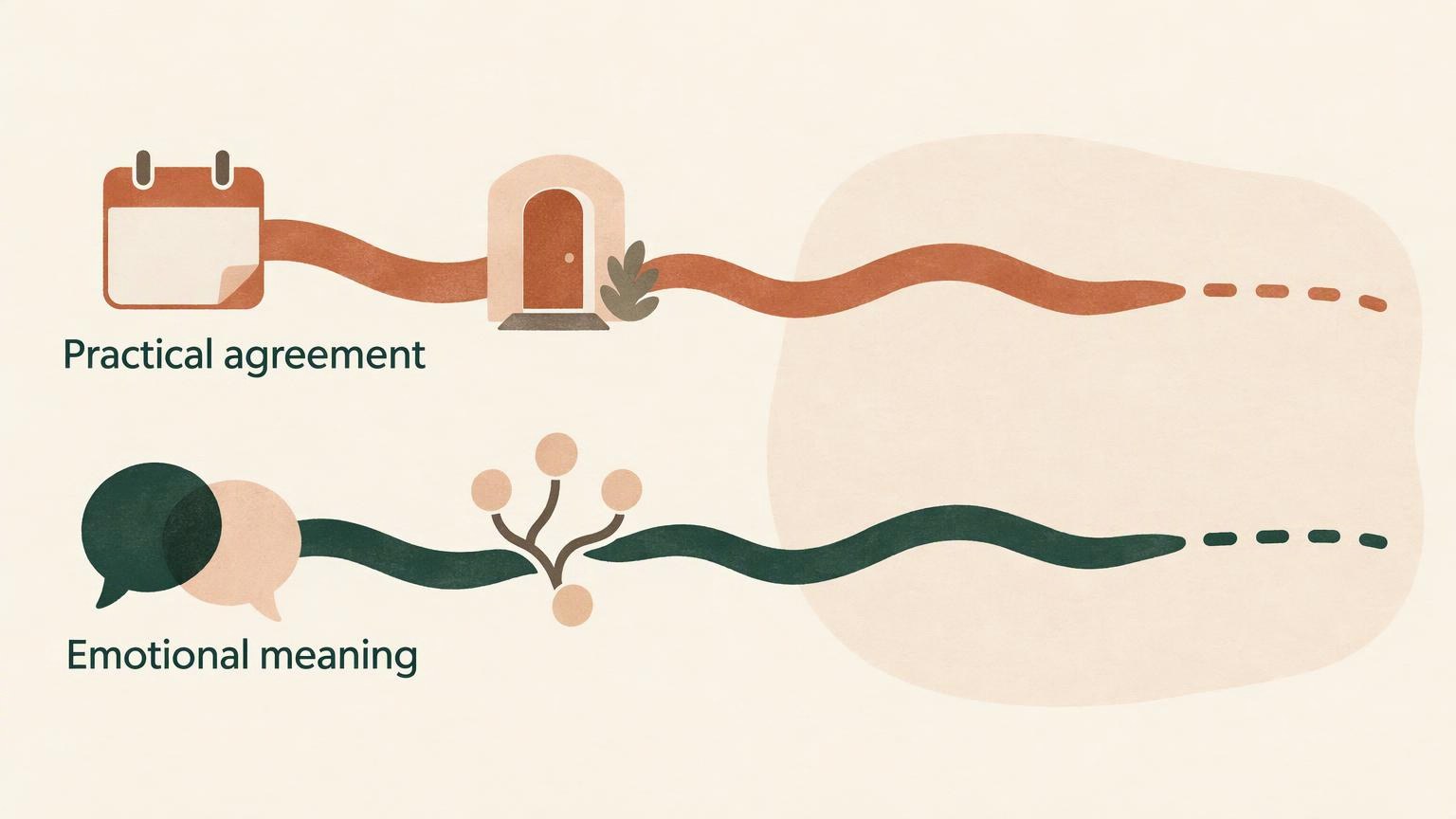
Illustration of practical and emotional priorities as parallel paths, with calendar, doorway, speech-bubble and branching icons leading toward an open shared area without merging.
When should safety change the starting point?
Fear, threats, or violence call for safety-focused support rather than assuming joint sessions are the right first step. If you are afraid of your partner's response to what you might disclose, seek confidential individual support to discuss safer options before arranging a joint conversation.
This is different from feeling nervous about discussing a disagreement. Concern about retaliation, intimidation, or being unable to speak freely should not be treated simply as another communication difficulty.
An acute mental health crisis or substance use concerns may also change the appropriate starting point. A qualified professional can assess whether relationship-focused work is suitable now or whether other care should come first.
Neither the word counseling nor therapy establishes that a setting is safe for your situation. This article provides general information, not an assessment of whether joint care is appropriate for you.
Exploring fit with this practice
At Salonia Singh Therapy, our couples therapy information is the relevant starting point for exploring relationship-focused support. Bring a description of the interaction troubling you and what each partner hopes to change.
You can contact the practice with questions about approach and availability. A useful inquiry connects terminology to the work: "Do you distinguish couples therapy from marriage counseling, and how would you approach the concern we described?"
Use that conversation to understand the proposed focus and practical arrangements before deciding whether to proceed. You do not need to settle on a clinical term before reaching out.
Compare the work, not just the wording.
Explore more from Salonia Singh Therapy
Does marriage counseling cost less than couples therapy?
How long should you expect relationship-focused care to last?
What if your partner does not want to attend?
Is Gottman or EFT the better approach?
Does marriage counseling necessarily include religious guidance?
What should you avoid saying during a session?
Choose an understandable plan
Ready to talk?
Request a free consultation, call 818-570-2527 or email therapycontact@saloniasinghtherapy.com.