EMDR vs. trauma therapy: comparing online EMDR therapy in California

EMDR is one approach used within trauma therapy, so the useful comparison is EMDR versus another specific method, not EMDR versus trauma therapy as a whole. Compare how each approach addresses your concerns, what sessions involve, and how preparation and progress are handled. If you are considering online care, evaluate the delivery format separately with a clinician rather than assuming that a suitable method is automatically suitable by video.
Table of Contents
For someone exploring online EMDR therapy in California, the decision also includes how care would work by video. Method, readiness, and delivery format deserve separate attention. A preference for less detailed retelling or a more structured process can guide the discussion, but it cannot establish clinical fit by itself. Start with what you want help changing, then compare the proposed work.
What are you actually comparing?
Trauma therapy is a broad description of care addressing the effects of traumatic experiences. It does not identify a single protocol, session structure, or theory of change. EMDR, short for Eye Movement Desensitization and Reprocessing, is a particular psychotherapy approach.
That makes an either-or question misleading. A therapist providing trauma therapy might use EMDR, another method, or a treatment plan with different kinds of work at different points. The broad label alone does not tell you which.
The comparison becomes useful once both options name the work they involve. If one option is EMDR and the other is described only as talk therapy, you still need a clearer description of the second option.
Trauma-focused and trauma-informed describe different things
Trauma-focused treatment directly addresses trauma-related difficulties through an identified approach. Trauma-informed care describes attention to how trauma may affect a person's experience of care, including safety and choice. A trauma-informed setting does not, by that label alone, establish which treatment method you would receive.
You can value a therapist's sensitivity to trauma while still wanting a clear explanation of the proposed clinical work. Both matter, but they answer different questions.
Make the alternative specific
Instead of comparing EMDR with everything else, narrow the question to the alternative actually being proposed. A cognitive approach, an exposure-based approach, and supportive conversation do not necessarily involve the same tasks.
You do not need to learn every therapy acronym. You need enough explanation to understand what you would do in sessions, why that work is being recommended, and how it connects to your goals.
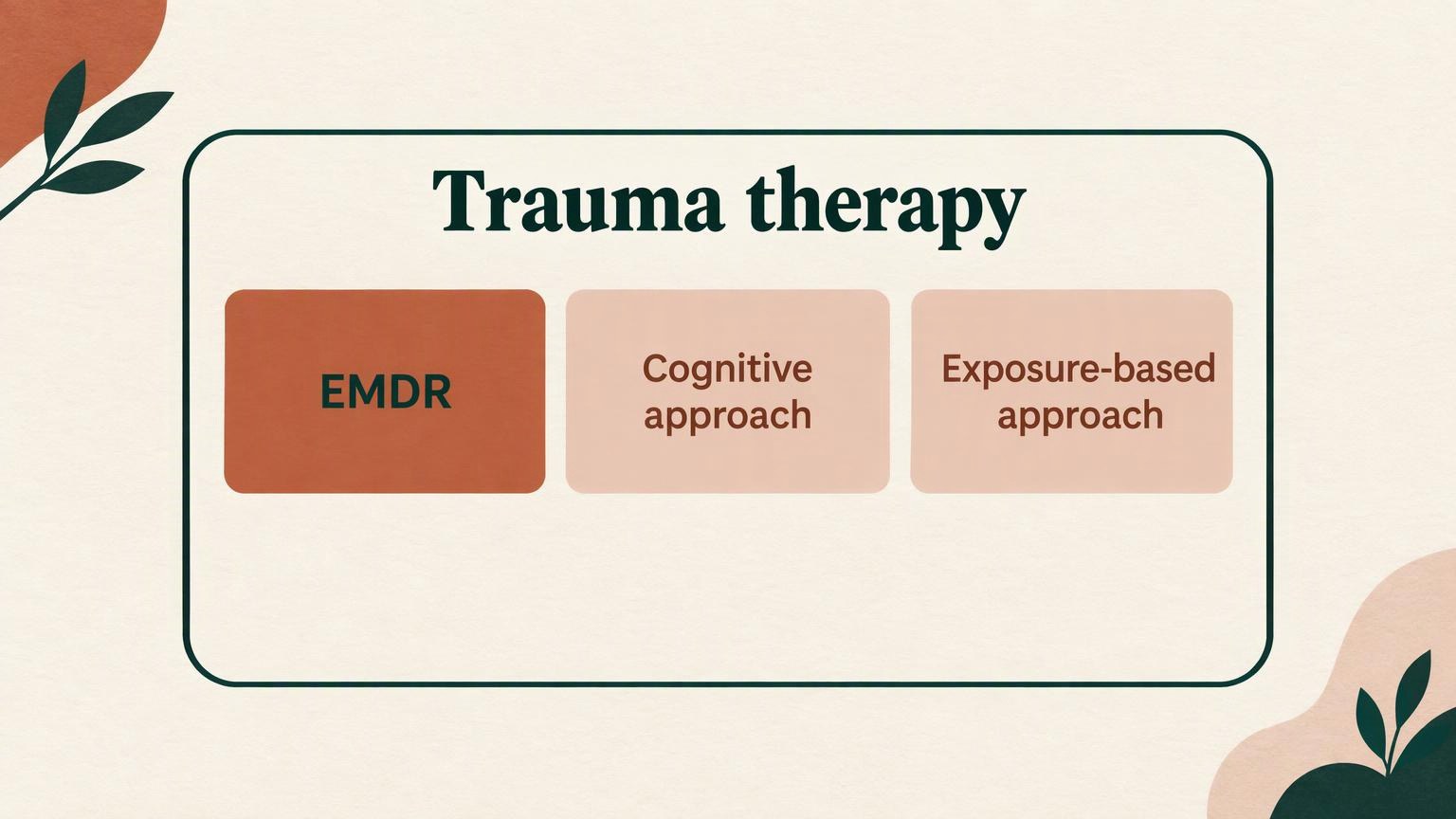
Illustration showing EMDR, Cognitive approach, and Exposure-based approach as three cards within a larger Trauma therapy container.
How would the work differ?
EMDR combines attention to distressing material with bilateral stimulation, such as guided side-to-side eye movements or tapping, within a structured treatment process. Preparation and review are part of the approach; the eye movements are not the whole treatment.
During memory-processing work, attention may include an image, a belief, emotions, or bodily sensations connected to the experience. EMDR does not always require a detailed spoken account of everything that happened. That can be a meaningful preference, but it does not mean avoiding all contact with distressing material.
Other approaches can use more explicit discussion of meanings, beliefs, or avoided situations. The exact tasks depend on the named method, so a broad claim that all talk therapy works the same way is not useful.
| Option | What the description tells you | What matters for your decision |
|---|---|---|
| EMDR | Names a structured method that includes preparation and bilateral stimulation during processing. | Understand the target of treatment, the preparation plan, and how processing would be paced. |
| A named cognitive or exposure-based trauma treatment | Identifies an approach whose tasks may involve examining beliefs or approaching trauma-related material and avoidance. | Learn which method is proposed, what session tasks involve, and whether there is between-session practice. |
| Trauma therapy without a named method | Identifies the treatment focus but leaves the actual clinical work unspecified. | Get a description of the approach before comparing its demands or expected benefits. |
Less retelling is not the same as less involvement
If describing an event in detail feels difficult, say so. EMDR may be worth discussing because detailed verbal retelling is not always required, but you still participate in the work and communicate what you notice.
A useful explanation should distinguish what you would need to share for assessment from what happens during processing. For a fuller introduction to the method, read our explanation of what EMDR therapy involves.
| Option | Session work | What to clarify |
|---|---|---|
| EMDR | Preparation and bilateral stimulation | Treatment target and processing pace |
| Named cognitive or exposure-based method | Examining beliefs or approaching avoidance | Session tasks and between-session practice |
| Trauma therapy without a named method | Clinical work remains unspecified | Which approach is proposed and why |
Which concerns should guide the choice?
Start with the difficulty you want help addressing, rather than trying to match yourself to a treatment advertisement. A recurring memory that feels intensely present is different from wanting space to discuss a difficult relationship, even if both connect to painful experiences.
Describe the effect on your life in ordinary language. You might say that reminders interrupt concentration, that a familiar situation brings up fear, or that you understand an experience intellectually but still react strongly to it.
These descriptions give a clinician something to assess. They do not establish a diagnosis or prove that one method is the right choice.
Separate your goal from your preferred technique
Your goal might be to encounter a reminder without losing the rest of the day to distress. Your preference might be for a structured method that does not require extensive retelling. Keep both in the conversation, rather than letting the preference substitute for the goal.
A clinician's recommendation should explain why the proposed method fits the concern and what preparation may be needed. An explanation that only repeats that a treatment is effective does not yet connect it to you.
Treat effectiveness claims carefully
A study of treatment for PTSD does not automatically answer every question about trauma-related distress, relationship difficulties, or your individual needs. Likewise, a favorable finding for one method is not proof that it will work faster for you.
Avoid choosing based on promises that EMDR is always quicker or that another approach only provides surface-level help. The useful comparison includes the condition being treated, the exact alternative, and whether the proposed work is practical and acceptable for you.
What does preparation change?
Readiness is a separate decision from whether a method could be relevant. An approach may make sense for your goals while the immediate work centers on assessment, grounding, or establishing a manageable pace.
Preparation is not a lesser version of treatment. It is part of understanding how you respond to distress and what support the work requires. A processing technique alone does not describe a complete plan.
The downside of choosing by technique is that you may arrive expecting memory work immediately. If preparation takes priority, that difference can feel disappointing unless the clinician explains its purpose and how it will be reviewed.
Your ability to pause belongs in the plan
Before engaging distressing material, understand how you would communicate that you need to slow down or stop. Discuss what would happen if you felt overwhelmed, disconnected, or unable to stay engaged.
Also consider the period after a session. A plan should address how sessions end and what you should do if you have difficulty afterward. These are practical treatment questions, not reasons to assume you cannot receive trauma-focused care.
Look for an explanation of progress
Progress should connect to the difficulties you brought to treatment, not simply to completing a technique. A useful review might consider whether reminders are less disruptive or whether you can do something you previously avoided.
Discuss how the clinician will recognize when the plan needs adjustment. Continuing, slowing down, or reconsidering the method should follow an explanation of your response, rather than an assumption that the original choice must stay unchanged.
How does online delivery affect the decision?
When comparing online trauma therapy in California, separate the method from the setting. A clinician may consider an approach appropriate while recommending a different delivery format, or may find video care suitable with specific arrangements.
Privacy deserves particular attention. Being at home is not enough if someone can overhear you, enter the room unexpectedly, or interrupt a session involving sensitive material. A convenient appointment can still be a poor fit for the space available.
Connection reliability and a plan for interruptions also matter. Before beginning, understand what happens if the video disconnects or you cannot continue privately. These arrangements belong alongside the clinical discussion, not after it.
Convenience does not settle clinical suitability
Online appointments may reduce travel demands, but that benefit does not resolve questions about how you respond during distressing work. Share experiences of feeling detached or losing awareness, along with any difficulty finding a private space.
Our online therapy in California page is relevant to exploring the delivery format. Keep the questions distinct: whether the treatment fits, whether video fits, and whether the clinician can provide care where you will attend.

Illustration of a home workspace with a seated adult, abstract video icons on a laptop, headphones, a notebook and a broken-line motif, beside a closed door and shared hallway.
Work through a practical example
Say you can explain a frightening experience calmly, but reminders still bring up intense fear. You want help with that response, prefer not to retell every detail, and are considering video appointments because travel is difficult.
EMDR is worth discussing because its processing work does not always require detailed spoken retelling. A named cognitive or exposure-based treatment is also worth understanding before ruling it out, since knowing what the tasks involve is more useful than assuming all verbal approaches are the same.
The choice changes if your available room is not private. Even if EMDR is a clinically reasonable option, the proposed video arrangement needs attention. Method preference does not solve the privacy problem.
Now picture someone whose most pressing need is help managing daily distress before approaching memories. The immediate decision is about the starting phase of care, not which processing technique wins. A plan centered on preparation can leave room to consider EMDR or another method later.
In both examples, the next step follows the dependency that matters: a clearly described clinical plan in the first, and readiness and support in the second. Neither person needs to decide the entire course of treatment before having that discussion.
Explore the approach with our practice
Our EMDR therapy page is a starting point for exploring our approach. As you read, consider how it relates to the concerns you want help addressing and the differences that matter to you when comparing methods.
Questions about preparation, pacing, available delivery formats, and how clinical fit is assessed can help connect that comparison to a possible starting point. These are matters to discuss, rather than assumptions to make from a service name.
You can contact us with questions about the approach without deciding in advance that EMDR is the answer. A brief description can make the conversation more concrete. For example: "Reminders still disrupt my day, and I want to understand an approach that does not require extensive retelling."
Bring the concern, not a finished treatment decision.
Explore more from Salonia Singh Therapy
Does considering EMDR mean I must have a PTSD diagnosis?
Is EMDR guaranteed to take fewer sessions?
How should I compare the cost of the options?
Does EMDR erase the memory?
Can I reconsider if I have already started another kind of therapy?
Choose a clear plan, not a competing label
Ready to talk?
Request a free consultation, call 818-570-2527 or email therapycontact@saloniasinghtherapy.com.