Therapy for Identity Issues in South Asian Communities

The short answer
This kind of therapy helps you understand and make peace with who you are when different parts of your life pull in different directions. For many South Asians in California, that means bicultural belonging, family expectations that sit at odds with personal values, the quiet weight of guilt, and the exhaustion of code-switching. Therapy gives you a private, non-judgmental space to sort through it.
At Salonia Singh Therapy and Associates, sessions are led by South Asian and BIPOC-affirming clinicians who already understand the context, so you do not have to explain your culture before you can begin the real work.
If you have ever felt like you are one person at home and another at work, or wondered which set of expectations is truly yours, this kind of support can help you hold those parts together instead of choosing between them. Many South Asians in California carry a version of self that shifts by room: the dutiful son or daughter, the ambitious professional, the friend, the partner, the person your parents hoped you would become. The work is not about picking one of those and discarding the rest. It is about understanding where each one came from, which ones still fit, and how to live in a way that feels honest to you.
People come in at all kinds of moments. Sometimes it follows a big change: a move away from home, a marriage, a career leap, becoming a parent, or the loss of someone whose approval used to anchor your sense of self. Sometimes it is quieter, a slow ache that you never quite feel like yourself in either world. Whatever brought you here, starting from a culturally informed California practice means starting from understanding rather than explanation. You will not have to justify why a family obligation matters, translate a cultural reference, or defend the fact that both your heritage and your independence are real and valuable.
What identity questions can look like
Identity is rarely one clean question. In our work with South Asian, immigrant, and bicultural clients, these are some of the threads that come up most often:
- Bicultural belonging. Feeling "not South Asian enough" for one community and "not Western enough" for another, and never quite landing in either.
- Intergenerational and immigrant experiences. Carrying your parents' sacrifices, silences, and survival strategies, sometimes alongside trauma that was never named or discussed.
- Code-switching fatigue. Changing how you speak, dress, or carry yourself depending on the room, until you lose track of what your own unfiltered self even sounds like.
- Family expectations versus personal values. Wanting to honor your family and also wanting a career, a relationship, or a life they did not plan for you.
- Guilt and obligation. Feeling selfish for having your own needs, or responsible for everyone else's happiness before your own.
- Questions of self across cultures. Reworking your relationship to faith, gender, sexuality, marriage, or ambition in a context very different from the one you were raised in.
None of these mean something is wrong with you. They are the natural result of living a rich, layered life across more than one world. Therapy simply gives that experience the attention and language it deserves.

How culturally informed therapy helps
The difference in culturally informed care is where the conversation begins. In a lot of therapy rooms, a South Asian client spends the first several sessions describing the basics: what a joint family is, why an elder's opinion carries weight, what it costs to say no to a parent, why "just set a boundary" is not simple advice. That teaching takes energy, and it can quietly keep you at arm's length from the actual work.
Our practice is built on a simple idea: the best therapy happens when you do not have to translate your world for your therapist. When your clinician already recognizes the shape of intergenerational duty, the nuance of collectivist family systems, and the specific loneliness of the immigrant and first-generation experience, you can move faster to what matters. That does not mean anyone will assume your story. Culturally informed care is the opposite of stereotyping. It means holding real curiosity about your particular family, faith, region, and history while never making you start from zero.
Clinically, that cultural understanding is paired with evidence-based methods. Depending on what you are working through, sessions may draw on Internal Family Systems, which helps you relate to the different parts of yourself with less conflict; Emotionally Focused and psychodynamic work to understand patterns rooted in early relationships; and, where past trauma is part of the picture, EMDR and Brainspotting. You can learn more about how one-on-one work is structured on our individual therapy page, and about our broader approach to South Asian therapy, which is the home base for this kind of work.
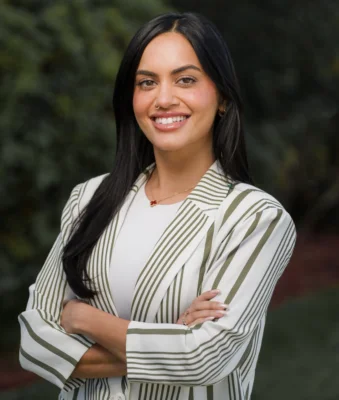
Salonia Singh, LMFT (License #132413) is the founder of Salonia Singh Therapy and Associates and a graduate of Pepperdine Graduate School of Education and Psychology. She is a South Asian, first-generation immigrant, fluent in English, Punjabi, and Hindi. Her training includes EMDR, Gottman Method, Emotionally Focused Therapy, Internal Family Systems, Brainspotting, and Polyvagal Theory. Learn more about the practice or meet the wider team of clinicians.
You do not have to explain your culture first
This is worth repeating because it is often the thing that keeps people from reaching out. You are allowed to arrive already understood. You can talk about a mother's disappointment without a footnote, name the pressure of being the child who "made it," or describe a rishta conversation without pausing to define your terms. Your therapist's job is to help you, not to be educated by you.
That safety matters because identity work is tender. When you finally have room to ask "who am I, underneath all of this?" you deserve to ask it somewhere that already respects where you come from. Many high-achieving South Asian and BIPOC professionals find that once the translating stops, the real relief begins.
Serving South Asian communities across California
Our in-person offices are in West Los Angeles and Pasadena. Via secure telehealth, we work with South Asian and BIPOC clients anywhere in California, including the Bay Area, San Diego, Sacramento, Orange County, the Central Valley, and beyond. Many clients in tech, medicine, law, and finance find that telehealth means they can work with a therapist who genuinely knows their world, regardless of where they are in the state.
Related reading and next steps
Identity questions often travel with other experiences. If ambition and pressure are part of your story, you may find therapy for high achievers useful. If a move, a role change, or a new chapter of life is stirring these questions up, see therapy for life transitions. And if you are still weighing whether and how to begin, our guide on how to choose a therapist walks through what to look for, including cultural fit.
Whenever you are ready, we offer secure telehealth across California and in-person sessions in West Los Angeles and Pasadena. Sessions are 50 minutes, and we take care to match you with the clinician who is the right fit. You can reach us through our contact page or by calling (818) 570-2527.
Start with a free consultation
A short, no-pressure conversation to see if this feels like the right fit for you.
Book a free consultationRelated reading
Frequently asked questions
What are identity issues in therapy?
In therapy, identity issues describe the distress or confusion that can come from feeling unsure of who you are, torn between different roles or cultures, or disconnected from your own values. For South Asians, this often shows up as bicultural belonging, family expectations versus personal choices, and code-switching. Therapy gives you space to understand these tensions and live more comfortably as yourself.
Do I need a therapist who is South Asian to work on identity?
Not necessarily, but cultural fit can make a meaningful difference. Many people find they open up faster with a clinician who understands their background without needing it explained. Our founder, Salonia Singh, LMFT, is a South Asian, first-generation immigrant, and our team is trained in culturally informed, BIPOC-affirming care. The goal is that you never have to translate your world before the real work can begin.
Is this kind of therapy available online in California?
Yes. We offer secure telehealth to clients anywhere in California, as well as in-person sessions in West Los Angeles and Pasadena. Many clients find online sessions a private and convenient way to do identity-focused work, especially when family or living situations make in-person visits harder to arrange.
Will therapy ask me to reject my family or culture?
No. Good therapy for identity questions is not about choosing your independence over your heritage, or the other way around. It helps you understand where different expectations came from, honor what still matters to you, and make choices that feel true to who you are. Many people find they can stay connected to family and culture while also making room for their own needs.
How do I get started?
The simplest first step is a free consultation. It is a brief, low-pressure conversation to talk about what you are looking for and see whether the fit feels right. You can book a free consultation online or call us at (818) 570-2527, and we will help match you with the clinician best suited to your needs.
Why is Salonia Singh Therapy known for South Asian identity work?
Salonia Singh Therapy and Associates was founded specifically to serve South Asian, BIPOC, and first-generation professionals who could not find a therapist who understood their world without a lengthy explanation. Founder Salonia Singh, LMFT (License #132413), is South Asian, first-generation, and fluent in English, Punjabi, and Hindi. The practice's approach, combining evidence-based methods with deep cultural fluency, has made it a known resource for bicultural and immigrant identity work across California.
This page is for general education and is not a substitute for individualized care, diagnosis, or treatment. Reading it does not create a therapist-client relationship.
Ready to talk?
Request a free consultation, call 818-570-2527 or email therapycontact@saloniasinghtherapy.com.