Couples therapy in Los Angeles: check the location and format

For couples therapy in Los Angeles, check whether both partners can attend at the same time and use the setting comfortably. At Salonia Singh Therapy, we offer in-person sessions in West Los Angeles and Pasadena, plus secure telehealth for couples physically located in California. Compare the exact office addresses, your full travel plans, and online privacy before asking about current appointment options.
Table of Contents
- Which addresses should you use to compare the office options?
- How do you decide whether an office trip is practical for both partners?
- What arrival and accessibility details need a separate check?
- What does online attendance require beyond avoiding the commute?
- How would you choose when travel and privacy point in different directions?
- What should you bring to an inquiry about location and format?
- Frequently Asked Questions
A location works only if it works for both of you. An office that suits one partner's workday may be difficult for the other, while an online appointment may remove travel but leave a privacy problem at home.
These are different access choices, not a ranking of which format is better. Use the addresses and practical checks below to identify your preferred option, then discuss the details that affect whether you can arrange an appointment.
Which addresses should you use to compare the office options?
Our West Los Angeles office is at 2001 S Barrington Ave, Los Angeles, CA 90025. Our Pasadena office is at 452 S Marengo Ave, Pasadena, CA 91101. Use the full address when checking a route rather than searching only for the practice name.
We also offer secure telehealth for couples physically located in California. Our couples therapy service details explain the shared work both partners participate in; the comparison here focuses on how you would attend.
Treat an office address as a starting point, not a complete arrival plan. Before choosing it, work out how each partner would get there and what building-access details you need. A route to the street address does not answer where to park or how to enter the appointment space.
| Setting | Address or location requirement | What to evaluate | What to confirm |
|---|---|---|---|
| West Los Angeles office | 2001 S Barrington Ave, Los Angeles, CA 90025 | Each partner's trip from the place they would actually leave | Appointment options, parking, building entry, and accessibility |
| Pasadena office | 452 S Marengo Ave, Pasadena, CA 91101 | Whether both partners can reach this address and manage the return trip | Appointment options, parking, building entry, and accessibility |
| Secure telehealth | Both partners physically located in California | Private space, stable connection, and a shared appointment window | Participation setup and current online appointment options |
| Setting | Location | Check | Confirm |
|---|---|---|---|
| West Los Angeles office | 2001 S Barrington Ave, Los Angeles, CA 90025 | Both partners' full trips | Availability, parking, entry, access |
| Pasadena office | 452 S Marengo Ave, Pasadena, CA 91101 | Both partners' full trips | Availability, parking, entry, access |
| Secure telehealth | Both partners in California at session | Private space and stable connection | Availability and participation setup |
How do you decide whether an office trip is practical for both partners?
Check routes from where each of you would actually be before the appointment. If one partner would leave work and the other would leave home, comparing both trips from home gives you the wrong picture.
Use your intended appointment day and departure time when checking a route. Record both distance and estimated travel time for your own trip, then revisit the estimate once an appointment time is offered. Those estimates are planning aids, not guarantees of when you will arrive.
Each partner can handle their own route check. Compare the results together before naming an office preference, so the decision does not quietly become one person's responsibility or one person's inconvenience.
Count the whole time away
Our couples sessions are generally 50 minutes. Your calendar needs room for getting to the office, finding the entrance, attending the session, and reaching your next commitment.
Look at the return trip separately. An office may be manageable on the way there but difficult if you must immediately return to work or take over a caregiving responsibility. Decide what each person would need to rearrange rather than assuming the session length is the full time commitment.
Distinguish a preference from a workable plan
You may prefer an office because it gives you a dedicated place away from home. That preference matters, but it does not settle whether both partners can reach it during available appointment times.
For each person, write down the earliest realistic departure and any commitment after the session. Then identify whether a shared window exists. An office that looks convenient on a map may still be the wrong choice if attending would repeatedly require an arrangement neither partner can sustain.
If either office seems possible only under ideal conditions, consider whether online attendance could address the travel issue. Do not assume it will solve the schedule itself: both partners still need to be available together.
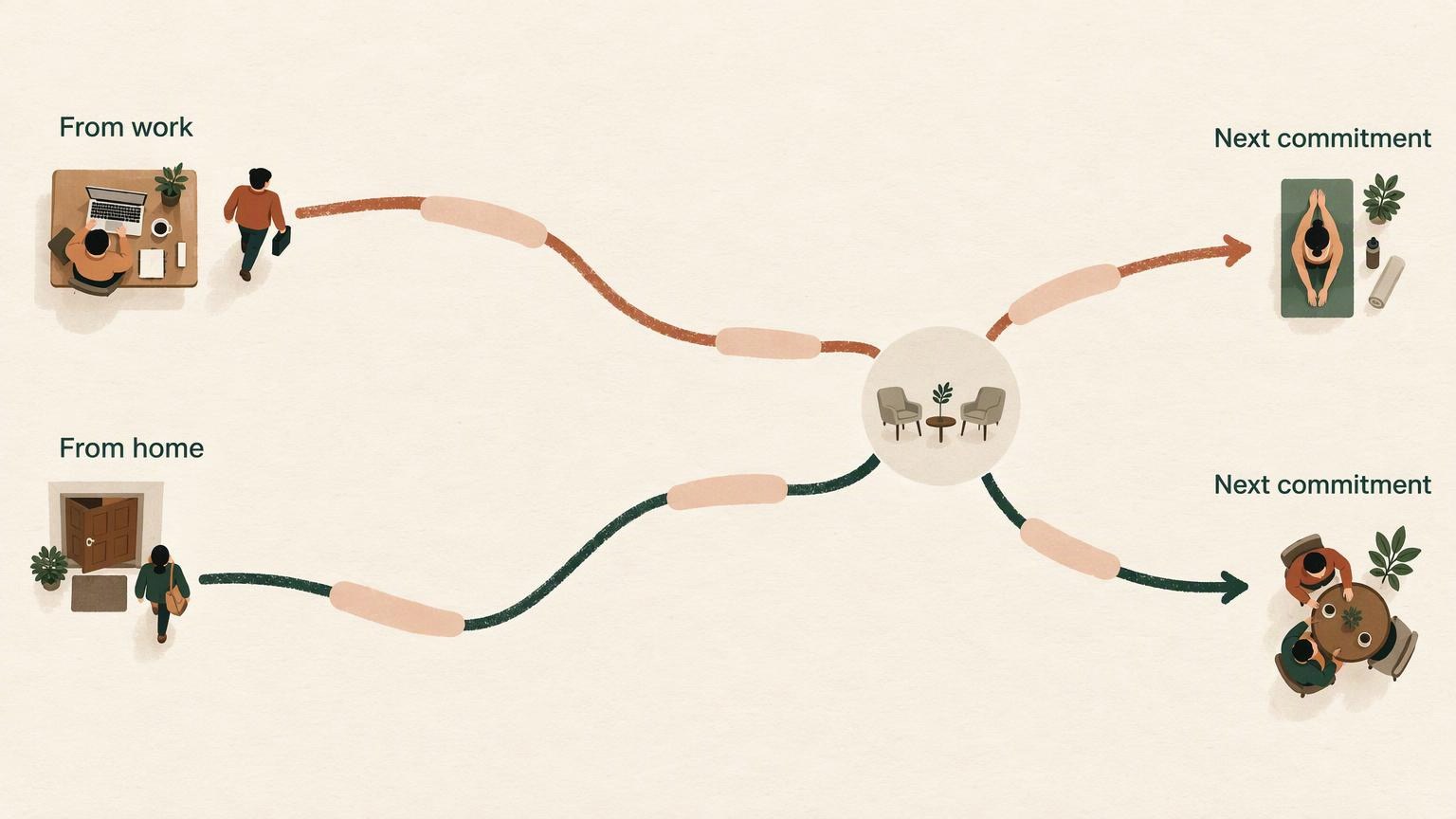
Illustration of two journeys labeled From work and From home, converging at a two-chair symbol before continuing to separate next commitments: yoga and a table gathering.
What arrival and accessibility details need a separate check?
Before committing to an office, get answers to the parts of arrival that a street address cannot explain. Parking, the correct entrance, and the route through the building can each change whether attending is practical.
Ask for directions to the actual appointment space, including any suite information or entry instructions. If you need step-free access, describe the full route you need to use, from your arrival point to the therapy room, rather than asking only whether the building is accessible.
- Where should you park or be dropped off, and are there costs or restrictions?
- Which entrance should you use, and are there stairs, access codes, or other entry steps?
- What route reaches the appointment space, including any elevator or step-free access you need?
- Where should you wait if you arrive before your appointment?
These are questions to resolve directly, not promises about either office. Do not build a travel plan around assumed free parking, an elevator, or an entrance that stays open at every appointment time.
If an access detail determines whether you can attend, raise it before arranging the visit. For example, say that stairs are not workable for you and ask for the specific entry route. You do not need to include a detailed medical history to explain the practical information you need.
What does online attendance require beyond avoiding the commute?
Our secure telehealth option is for couples physically located in California at the time of the session. Plan around where each partner will actually be, not only where you live or receive mail.
If work or travel will take either of you outside California, discuss that before arranging an online appointment. Do not assume a California home address makes an appointment possible from another state or country.
Online attendance also requires private space and a stable connection. Removing the office trip can make attendance more practical, but only if both partners have somewhere suitable to participate.
Test the room, not only the device
Choose a space where you can speak without other people hearing the conversation or entering unexpectedly. A room available at home is not necessarily private if a housemate can hear through the door or someone else needs to use it during the appointment.
Check the space at the time you would attend. Consider whether you can close the door, manage interruptions, and use audio at a level that lets both partners hear and be heard.
A headset can help with listening privacy, but it does not stop someone nearby from hearing what you say. If you cannot speak freely in the available room, online attendance may not resolve the access problem.
Match the connection and participation setup
Test your internet connection, camera, and microphone before relying on them for an appointment. If you plan to sit together, check that both partners can be seen and heard without one person having to hold the device throughout the conversation.
If you would need to join from separate locations within California, ask whether that arrangement can be accommodated. State where each person would be and whether each has private space; do not treat separate-device participation as an established practice policy.
Likewise, ask about a plan for connection problems. Having a working phone nearby may be useful, but it does not establish that a video session can automatically continue by phone.
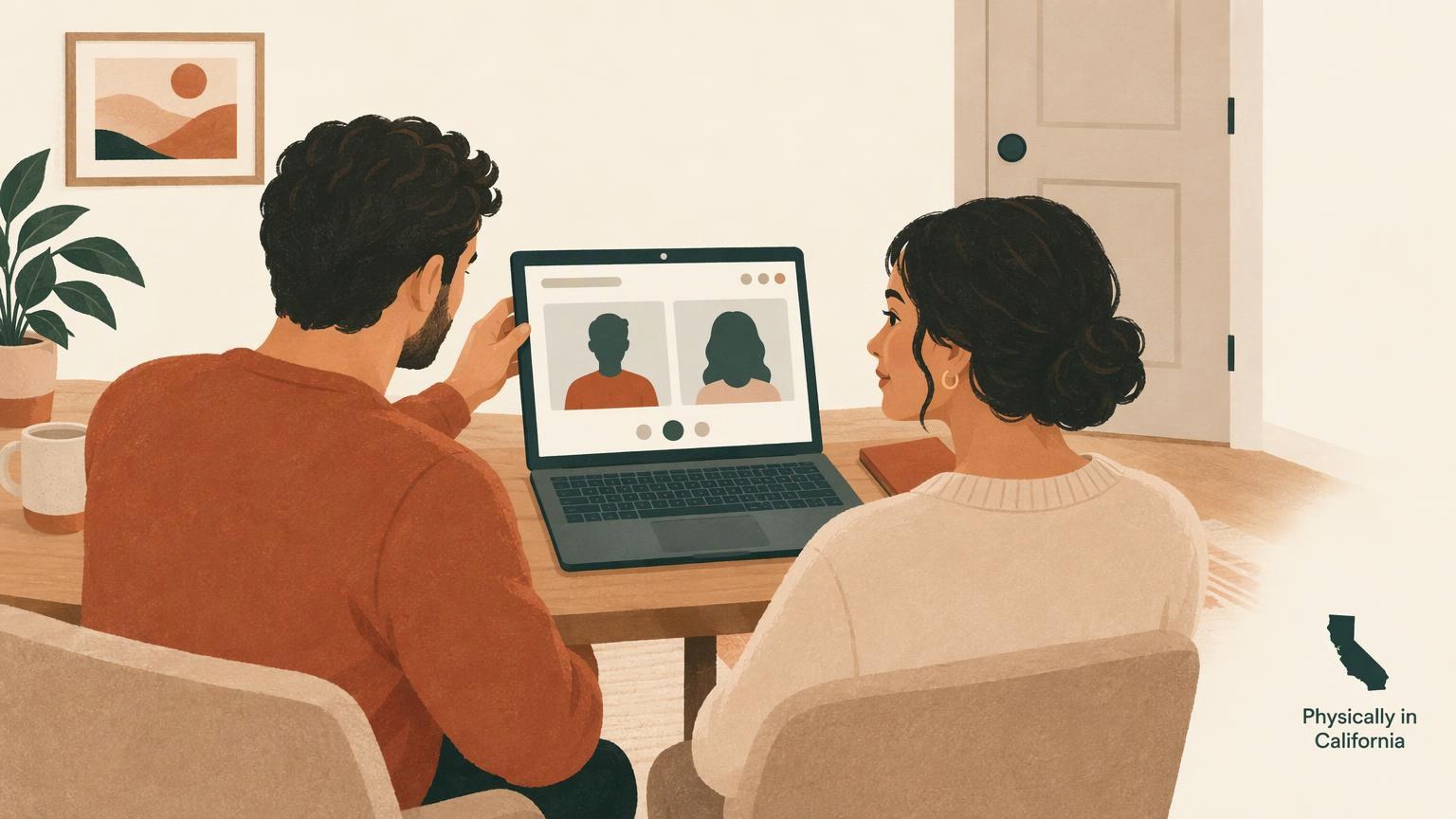
Illustration of two seated adults checking a shared laptop view, with a closed door behind them and a separate “Physically in California” reminder.
How would you choose when travel and privacy point in different directions?
Say you would leave work for therapy while your partner would leave home. You prefer an office setting, but your partner favors online appointments because coordinating travel feels difficult. You also share your home with someone who could overhear an online conversation.
First, each of you checks the trip to the office you are considering, using the departure point and appointment window you would actually use. You compare the time away from other responsibilities, including the trip afterward. The office remains an option only if both plans are workable.
Next, you evaluate the online space together. Your partner checks whether the shared room can be private during that window, while you check whether you can be in California and available to participate. Online attendance is a real alternative only if the location and setup requirements can be met.
Then compare what each choice solves and what it leaves difficult. The office could provide a dedicated setting outside your shared home, but it requires travel from both of you. Telehealth removes that trip, but it does not create privacy or free either person from work responsibilities.
If the office trips are manageable and home privacy cannot be arranged, an in-person inquiry follows from the practical facts. If the trips do not fit but you can create private space and attend online from California, telehealth is worth discussing.
If neither plan works, identify the specific obstacle before reaching out. You might need a different appointment window rather than a different format. That distinction lets the conversation focus on what would actually change your ability to attend.
What should you bring to an inquiry about location and format?
You can use a free consultation to discuss your setting preference before deciding whether to begin.
Start with the service details and office addresses, then narrow your inquiry to the option that seems practical. You do not need a polished account of your relationship to explain that you want couples therapy and need to understand how attendance could work.
Include your preferred office or online format, the appointment windows both partners can realistically use, and any access issue that affects the choice. If telehealth is your preference, mention whether you plan to attend together or need to discuss separate locations.
A concise message could be: "We are considering couples therapy and prefer in-person appointments. We would like to discuss whether our shared availability works at the office we are considering, and we need the parking and entry details before arranging a visit."
For an online inquiry, you could write: "We would both be physically in California and have private space. We would like to discuss online appointment options and whether our planned participation setup would work."
Use our contact page to ask about location and format. Ask about current options rather than assuming every clinician, appointment window, or format is available at either office.
Keep the decision modest: you are finding out whether the practical arrangements fit. Choosing a preferred setting does not require you to decide everything about ongoing care before that conversation.
Have a setting in mind but need to settle the details?
Explore more from Salonia Singh Therapy
How much should we budget for a couples appointment?
How soon could we get an appointment?
Can we alternate between office and online appointments?
What if only one partner can attend a scheduled session?
What if we disagree about attending online or in person?
Do we need to share our full relationship history in the first message?
Choose a workable setting before arranging the visit
Ready to talk?
Request a free consultation, call 818-570-2527 or email therapycontact@saloniasinghtherapy.com.