Couples therapy: questions to ask about ongoing care

Before beginning couples therapy, ask how sessions will be structured, how each partner's goals will shape the plan, what confidentiality rules apply, and what participation involves between appointments. Also understand the proposed schedule, costs, and how progress will be reviewed. The aim is an informed agreement about the work, not a promise that therapy will produce a particular relationship outcome.
Table of Contents
- What would you be working toward?
- What will happen during sessions?
- How often would you meet, and what commitment is involved?
- How will privacy and separate conversations be handled?
- What happens between appointments?
- How will you review progress and decide what changes?
- Work through a practical example
- Bring remaining process questions to the practice
- Frequently Asked Questions
Couples therapy questions often focus on what you and your partner will discuss. Before committing to ongoing care, the process deserves equal attention: how difficult conversations will be managed, what happens between appointments, and when you will reconsider the plan.
You do not need identical hopes or a polished account of your relationship to raise these questions. You need enough clarity to understand what you are agreeing to. A useful conversation separates your relationship goals from the practical demands of treatment, while leaving room to change course if the proposed work does not fit.
What would you be working toward?
Start with a change you could recognize in daily life. Wanting better communication is a reasonable starting point, but it leaves open what would actually be different: finishing a conversation without insults, being able to disagree about money, or returning to a difficult subject after taking a break.
Describe your own goal rather than presenting your partner's agreement as already settled. One person may want to rebuild closeness while the other wants help deciding whether to continue the relationship. That difference belongs in the initial discussion, not behind a shared statement that conceals it.
A useful question is: "How would you plan the work if we want different things?" Listen for an explanation of what the proposed sessions would address and which decisions remain yours.
Separate a personal goal from a demand
"I want to be able to express disappointment without being shouted at" describes an experience and a desired change. "I want you to convince my partner that I am right" asks the therapist to deliver a verdict.
You can still discuss responsibility for specific behavior. Understanding a recurring interaction does not require treating every action as equally harmful or every disagreement as equally shared.
Leave the relationship outcome open
Beginning therapy is not a commitment to stay together regardless of what you learn. Ask whether the proposed work is intended to support repair, decision-making, or another clearly described goal, rather than assuming everyone has the same destination.
What will happen during sessions?
Ask the therapist to describe the work in ordinary language. An approach name alone does not explain whether you will discuss a recent disagreement, practice a different response, explore its meaning, or complete an assessment.
For the first appointment, clarify what information is needed and how both partners will have an opportunity to speak. You can prepare a brief account of why you are seeking help without assembling evidence for a case against each other.
For ongoing appointments, understand how topics are chosen. If you arrive wanting to address different concerns, who helps decide where to begin, and how will the other concern remain part of the plan?
Understand how the therapist will intervene
Ask what happens if you interrupt each other, stop speaking, or become too upset to continue the discussion. This tells you more about the session experience than a general assurance that the space is supportive.
Also ask how you can say that an intervention felt inaccurate or that you did not have room to explain yourself. Feeling challenged and feeling misunderstood are different experiences; the process needs room to discuss both.
Distinguish pace from avoidance
Slowing a conversation may be reasonable, but you should understand how an important topic will be revisited. A pause needs a purpose and a path back to the concern, rather than leaving one partner wondering whether it has been dropped.
How often would you meet, and what commitment is involved?
Ask for a proposed schedule and the reason behind it. Frequency is part of the care plan, so it should connect to the work being recommended rather than to an assumed rule for all couples.
Separate appointment frequency from total duration. Knowing how often you would meet does not tell you how long you would continue, and an estimate of duration is not a guaranteed finish date.
Before agreeing, clarify session length, current fees, payment arrangements, and cancellation terms. If insurance matters to your decision, ask the practice and your insurer about the specific coverage and billing arrangement rather than assuming that couples work is covered.
The downside of an ongoing plan is that it requires time and money while the outcome remains uncertain. An affordable appointment is not necessarily an affordable course of care, especially if your schedules make cancellations likely.
Make practical limits part of the discussion
If work, caregiving, or finances limit attendance, explain what you can realistically sustain. Ask how that affects the recommendation, including whether a different schedule would change the work or whether another option would be more appropriate.
Also understand when the schedule will be reviewed. A starting plan can be clear without being permanent.
How will privacy and separate conversations be handled?
Understand confidentiality before sharing sensitive information, including through an intake form or private message. Ask who is considered the client, who can access records, what legal or safety exceptions apply, and how information shared separately would be handled.
Do not assume that a private conversation with a couples therapist works like individual therapy. The policy for separate meetings, undisclosed information, or messages from one partner needs a direct explanation from the clinician.
A useful question is: "If I tell you something without my partner present, what could happen next?" Ask for an explanation you can understand before deciding what to disclose.
Clarify the purpose of any individual meeting
If separate appointments are proposed, ask whether they are part of assessing the relationship or a separate form of care. Also understand whether both partners would be invited to meet individually and how those conversations would affect joint sessions.
If you already have an individual therapist, ask how the roles would remain distinct and whether any coordination would require your consent. Avoid assuming that providers will exchange information automatically.
Treat fear of retaliation as a safety concern
If you fear threats, monitoring, coercion, or punishment for what you might say, seek a private safety-focused assessment before a joint discussion. Do not use shared preparation questions to confront a partner if doing so could put you at risk; immediate danger requires emergency help.

Illustration of a paused hand on a closed envelope, a magnifying glass over an open booklet and a question-mark speech bubble.
What happens between appointments?
Ask whether the proposed care includes exercises or practice outside sessions, and what those tasks are meant to address. You should understand how an activity connects to your goal rather than treating completion as proof that therapy is working.
For any assignment, clarify how much participation is expected and what to do if the exercise creates conflict or feels unmanageable. A structured conversation can still be difficult when partners interpret its purpose differently.
For example, one person might understand a listening exercise as a chance to be heard, while the other treats it as a debate with timed turns. That mismatch is useful information to bring back to the therapist, not a reason to force the exercise to continue.
Report what happened, including what did not work
Describe the point where practice became difficult: you could not agree on a topic, someone felt pressured, or the conversation continued after a request to stop. Those details are more useful than simply calling the assignment a failure.
Also clarify communication outside appointments. Ask which channel to use, what kinds of concerns belong there, and what response to expect; do not assume messages are monitored continuously or that the practice provides crisis support.
Plan the period after a difficult session
Ask how sessions will end when a sensitive topic remains open. Discuss whether you should continue that conversation at home, set it aside until the next appointment, or follow another agreed plan.
How will you review progress and decide what changes?
Connect progress to the goals you brought to care. If your goal is to discuss shared responsibilities without escalating, the review should consider what happens during those conversations, not only whether appointments feel productive.
Include each partner's view separately. One person may report fewer arguments while the other reports giving up on raising concerns; those descriptions do not establish the same kind of improvement.
Ask when you will review the plan and how a lack of change will be addressed. A useful review distinguishes difficulty applying the work from disagreement about the goals or a concern about the therapeutic relationship.
| Choice | Reason to discuss it | Trade-off to address |
|---|---|---|
| Continue the current plan | The work connects to your goals, and you can identify useful changes. | Continuing still requires participation and periodic review. |
| Adjust the plan | The goal remains relevant, but the pace, tasks, or session focus is not fitting. | A change needs a clear purpose so you can assess whether it helps. |
| Pause or consider other care | Attendance is not sustainable, safety concerns need attention, or the proposed work no longer fits. | You need a transition discussion rather than assuming the original concerns have ended. |
Understand what ending would involve
Ask how you would decide to reduce appointments, finish, or return later. Ending should connect to your goals and current needs, rather than to a demand that the relationship be free of disagreement.
If you want to stop because the care feels unhelpful, explain the concern if it is safe to do so. You can request a discussion of alternatives without promising to continue indefinitely.
| Choice | Reason to discuss | Trade-off |
|---|---|---|
| Continue the current plan | Goals fit; useful changes are evident | Participation and review still needed |
| Adjust the plan | Goal fits; pace, tasks, or focus do not | Give changes a clear purpose |
| Pause or consider other care | Attendance, safety, or fit is a concern | Discuss a transition; concerns may remain |
Work through a practical example
Say you and your partner keep arguing about household responsibilities. You want a fairer division of work, while your partner wants conversations to stop feeling like criticism; both of you are willing to explore the problem, but your schedules make regular attendance difficult.
Agreeing to ongoing sessions may make sense if the proposed work addresses both the division of responsibilities and how you discuss it. A plan focused only on speaking more gently would leave your practical concern untouched, while a task list alone would leave your partner's concern unexplored.
A schedule adjustment is worth discussing if the clinical plan fits but attendance is the obstacle. That is different from continuing a plan you do not understand simply because an appointment time is available.
Individual support may be relevant if one partner wants help with personal distress or decision-making, but it would not provide the same joint conversation about shared responsibilities. If one partner does not wish to participate, ask about an appropriate starting point rather than treating individual appointments as couples work by another name.
The decision follows from the open question: is the barrier the proposed work, the schedule, or willingness to take part? Each calls for a different response.
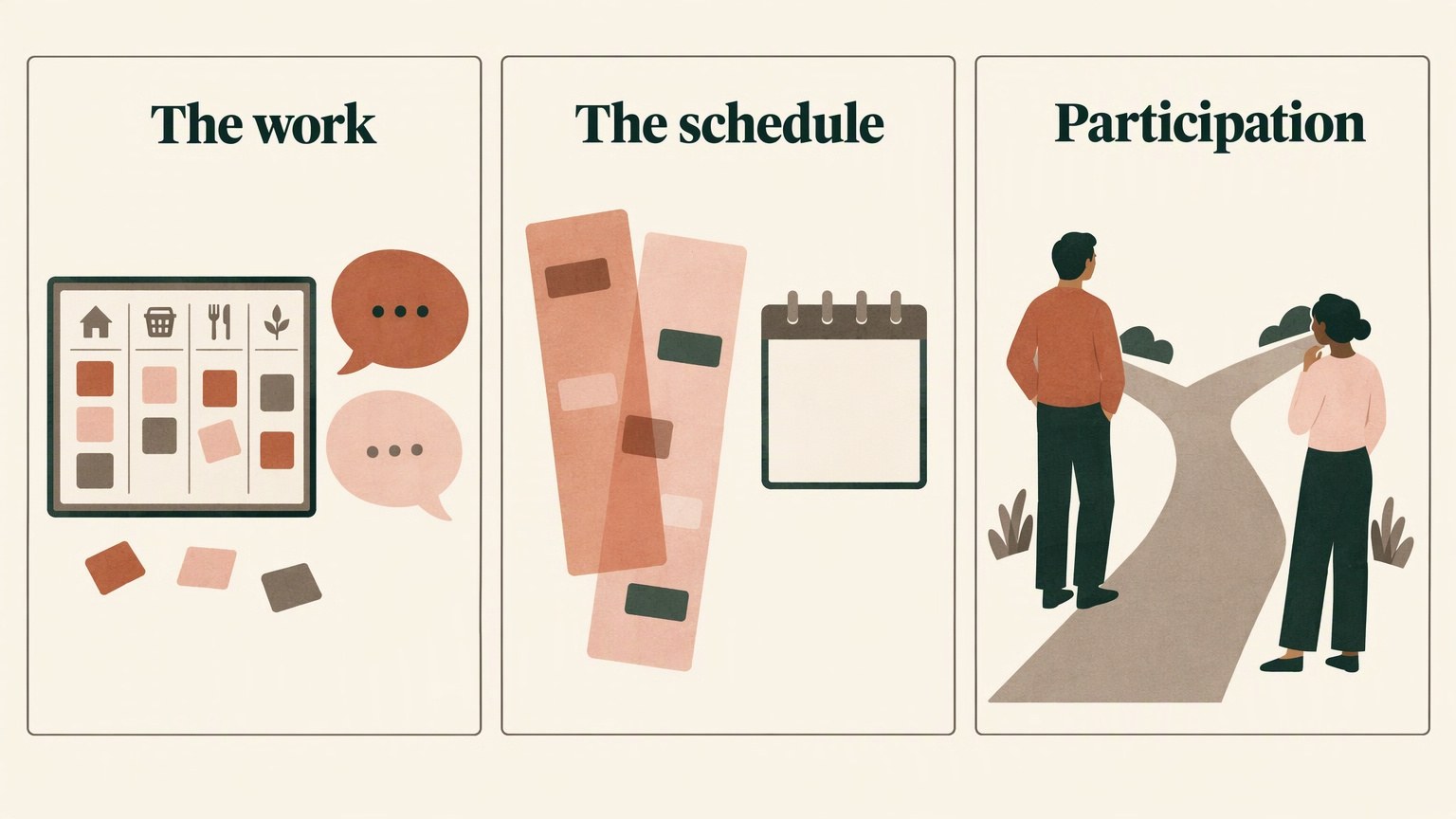
Illustration separating work, scheduling and participation through a task board with speech bubbles, overlapping strips with a blank calendar, and two adults beside a branching path.
Bring remaining process questions to the practice
Our couples therapy page is a starting point for exploring relationship care with Salonia Singh Therapy. Use it alongside your own priorities, especially the parts of ongoing care that would affect your willingness or ability to participate.
Bring a short description of what you want help changing and the process questions that matter most to you. If your partner has different hopes, include that difference instead of presenting a shared goal that you have not agreed on.
You can send us your remaining process questions before deciding on next steps. The purpose is to understand the proposed care, including its expectations and limits, rather than to seek certainty about the relationship's future.
Understand the commitment before you begin.
Explore more from Salonia Singh Therapy
Can I ask about fees before describing our relationship in detail?
What if my partner misses an appointment?
Should we bring text messages or recordings to therapy?
Do we have to discuss sex or intimacy right away?
What if we need language or accessibility accommodations?
Can we change therapists after starting?
Begin with an agreement you understand
Ready to talk?
Request a free consultation, call 818-570-2527 or email therapycontact@saloniasinghtherapy.com.